Service Repair Costs, Technology and Retention: The Fixed Ops Edge
Updated November 2026.
Service repair costs, technology and retention now sit at the center of every fixed ops plan: car repair costs are up 60% since 2019, and ADAS (advanced driver assistance systems) calibration is a big reason why. Dealerships with calibration equipment and VIN-verified ownership data can capture the repair orders (ROs) that priced-out independent shops and generic service reminders are losing.
Key takeaways
Repair costs rose 60% from January 2019 to August 2026, nearly double the 32% rise in overall inflation over the same period, per Car Dealership Guy News, citing CNBC (Consumer News and Business Channel).
ADAS calibration alone can add 37.6% to a collision repair bill, according to a 2023 AAA (American Automobile Association) study cited in the same report.
A full calibration array can run up to $90,000. Most independent shops can't justify that cost, which gives dealership service departments a structural edge.
That equipment edge only turns into gross if a dealer knows which vehicles in its market actually carry ADAS hardware and when they're due for calibration.
VIN-verified ownership data turns ADAS complexity into a targeting advantage for service retention and conquest. It's not just a cost dealers have to absorb.
Why have car repair costs jumped 60% since 2019?
Repair costs rose 60% from January 2019 to August 2026. That's nearly double the 32% rise in overall inflation over the same stretch. Vehicle technology is driving much of that gap, according to Car Dealership Guy News, citing CNBC.
The average repair now costs $838 for routine or moderate work. One third of drivers can't cover an unexpected $500 repair without going into debt. Vehicle repair and maintenance costs have climbed 33% since 2021 alone, per Bureau of Labor Statistics data cited in the same report. None of that is a blip. It's the predictable result of putting more cameras, radar and software into every new vehicle that rolls off a lot.
How much does ADAS calibration add to a collision repair cost?
A 2023 AAA study found that calibrating ADAS can raise the cost of a collision repair by 37.6%, per reporting on the data, which also cited CNBC's coverage of the trend. That's a real cost increase tied to the sensors and cameras that now ship standard on most new vehicles.
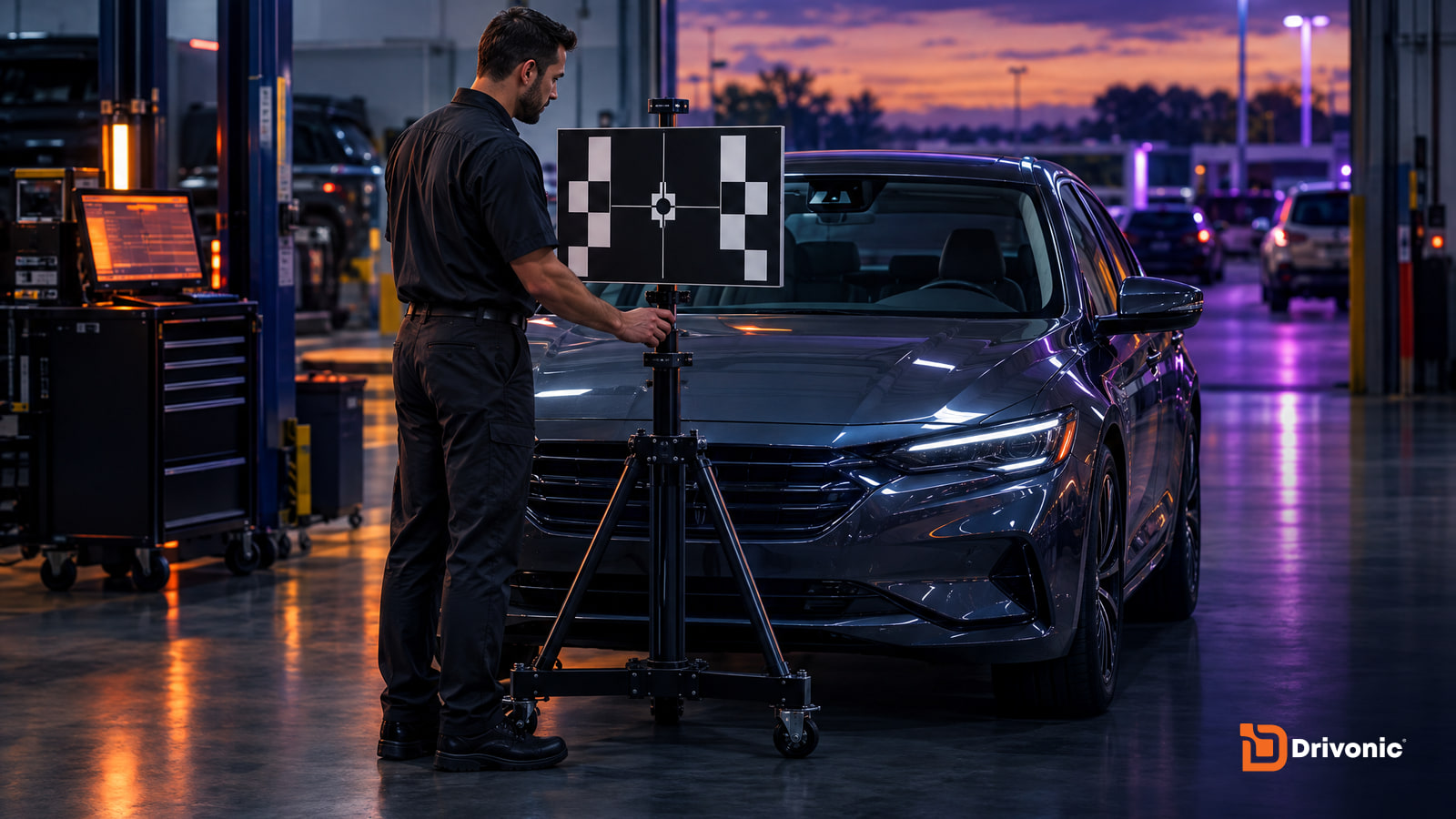
The equipment behind that cost is not cheap. A single calibration machine costs about $28,000. The computer required to run it adds another $12,000. A full array, with target boards built for specific cameras, can run up to $90,000. Ralph Czeisler, who owns Emil's All-Tire in Brooklyn, told CNBC he updates his computers every year because manufacturers keep changing their systems, and each update adds cost on top of the last.
That's the real story behind ADAS calibration repair costs. It's not one expensive tool. It's a repeat bill that most single-location independent shops can't keep paying.
Why does windshield replacement now require camera recalibration?
Windshield replacement now requires recalibrating the camera mounted behind the glass, not just installing new glass. Lane keeping, automatic emergency braking and adaptive cruise control all depend on a forward-facing camera behind the windshield. Any disturbance to that mounting point can throw off the calibration those systems rely on.
A shop that swaps the glass and sends the car out the door hands the owner a vehicle with safety systems that may not read the road correctly. That's the kind of job a shop without a calibration array has to turn away or sublet to someone else, often a nearby dealership or a mobile calibration specialist. That's where dealership service departments start pulling ahead.
Independent shop vs dealer service costs: who's actually equipped for ADAS repairs?
Dealership service centers are generally better positioned than independent repair shops to handle the operating costs of servicing higher-tech vehicles, per CNBC reporting. Many franchise stores also face OEM (original equipment manufacturer) certification requirements that mandate specific calibration equipment and training, costs most independents never take on in the first place. The gap shows up clearly when you compare what each side is working with.
Factor | Independent shop | Dealership service department |
|---|---|---|
Calibration equipment investment | Hard to justify a $90,000 array against local ADAS repair volume | Spread across franchise-level volume and often required by the OEM agreement |
Annual software and computer updates | Out of pocket, repeated yearly as manufacturers change systems | Built into OEM training and service channels |
Access to VIN-level vehicle specs | Limited, often requires third-party lookups | Direct access through OEM systems and VIN-verified data |
Typical outcome on ADAS work | Turn away, sublet, or refer to a specialty calibration shop | Capture the RO and keep the customer relationship |
Service repair costs, technology and retention: what fixed ops directors need to know
CNBC's reporting shows the real divide. ADAS-equipped vehicles need calibration. Most independent shops can't justify spending $90,000 on an array to do it. For dealers, that's a chance to win new service customers, not just hold on to the ones they already have.
LaneDriver℠ turns that ownership and service-behavior data into actual outreach, built to win back lapsed customers and pull in owners currently paying an independent shop for work the dealer is better equipped to handle. MobileLync℠ adds the conquest layer for owners currently serviced at a competing rooftop. See our fixed ops growth and retention strategy for Q4 2026 for more on building that program.
How can dealers target ADAS owners for service conquest and retention?
Dealership service conquest marketing works best when it starts with data, not a mailer list. Here's a practical sequence for fixed ops teams building a 2026 retention strategy around ADAS complexity:
Identify which VINs in your primary market area carry ADAS hardware, since not every model year or trim does.
Flag service triggers tied to that hardware, such as windshield claims, collision repairs and sensor fault codes, not just mileage-based reminders.
Prioritize outreach to owners who are overdue or showing signs of defecting to an independent shop that can't offer calibration.
Set up alerts when a tracked vehicle shows activity at a competing dealership's service lane, so an advisor can follow up fast with a specific offer.
Track RO capture rate against your target list, not just response rate. That's what tells you whether the program is moving gross, not just clicks.
What this means for your dealership
The equipment side of this math favors dealers. But owning a calibration array doesn't guarantee you capture the RO. The data on who owns what, and who's due for service, decides that.
Audit your calibration equipment against the ADAS mix actually registered in your market, not against last year's assumptions.
Pull VIN-verified ownership data to find ADAS-equipped vehicles currently serviced elsewhere, including at independent shops that can't do the calibration work.
Build service reminders around specific triggers (windshield replacement, collision history, sensor faults) instead of generic mileage intervals.
Train advisors to explain the calibration requirement plainly: it keeps the safety system working, not an optional upsell.
Track service retention rate and RO capture rate side by side, since that pairing shows whether you're keeping customers and winning new ones.
Frequently asked questions
Why have car repair costs risen 60% since 2019?
Repair costs rose 60% from January 2019 to August 2026, nearly double the 32% rise in overall inflation. Newer vehicles carry more sensors, cameras and software, and those parts cost more to service and recalibrate after repairs.
How much does ADAS calibration add to a collision repair?
A 2023 AAA study found ADAS calibration can raise the cost of a collision repair by 37.6%, driven by the cameras and sensors that need to be reset after the vehicle's body or glass is disturbed.
Why does windshield replacement now require camera recalibration?
Many ADAS features depend on a forward-facing camera mounted behind the windshield. Replacing the glass disturbs that mounting point, so the camera has to be recalibrated to keep lane keeping, automatic braking and similar systems working correctly.
Are dealership service departments better equipped than independent shops for ADAS repairs?
Generally, yes. CNBC reporting found dealership service centers are better positioned than independent shops to absorb the equipment and training costs that higher-tech vehicles require, including calibration arrays that can cost up to $90,000.
How can dealers identify which vehicles in their market need ADAS calibration service?
VIN-verified ownership data can flag which vehicles in a dealer's market carry ADAS hardware and when they're due for service. That lets fixed ops teams target specific owners instead of sending blanket reminders to the full customer list.
What should a dealer invest in to capture more high-tech repair business?
Beyond calibration equipment, dealers need a way to match that capability to the right owners at the right time. That means investing in ownership and service-behavior data alongside the equipment itself.
Schedule a demo to see how IRIS℠ and LaneDriver℠ can turn ADAS ownership data into more captured ROs: https://drivonic.com/schedule.
Sources
- Car repair costs surge 60% as advanced vehicle technology drives up service expenses, Car Dealership Guy News
About the author
Automotive data and marketing analysts
Drivonic is a dealer-owned data and technology company with over 10 years of automotive data excellence. It turns fragmented automotive data into sales outcomes for dealerships, OEMs, Tier 2 associations and marketing agencies. The editorial team turns IRIS℠ audience data and industry reporting into practical guidance for dealership leaders.
More from DrivonicRelated articles
Compact Car Inventory Shortage Strategy: What Dealers Do Now
October 6, 2026

Lead Follow-Up Speed and Dealer Conversion: A 30-Store Study
October 5, 2026
Fixed Ops Growth Service Retention Strategy for Q4 2026
September 30, 2026